
Most designers start with a great idea and stall somewhere between a sketch and a manufacturer asking for files they’ve never heard of. This guide covers the actual steps how to design clothes from your first rough drawing to a garment that’s ready to cut and produce.
Starting With Your Idea: Sketching, Mood Boards, and Defining Your Aesthetic
A mood board without a point of view is just a Pinterest board. The goal at this stage is not to collect images you like — it’s to find the visual thread connecting them. If every reference image you pull has clean lines, muted tones, and minimal hardware, that’s a design direction. If the board has streetwear next to prairie silhouettes next to techwear, you don’t have a concept yet.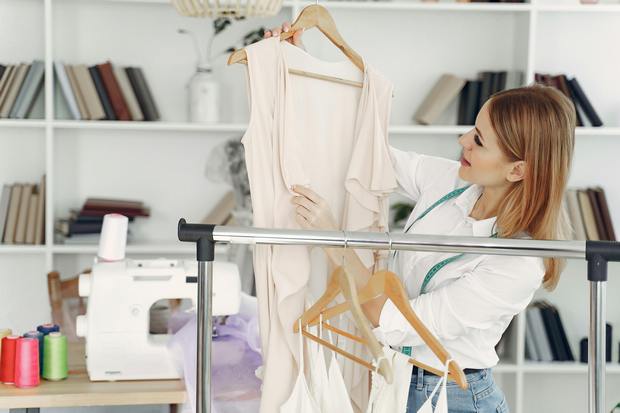
Hand sketches work better than most designers expect. You don’t need to draw well, just fast enough to capture what you’re picturing before you lose it. A front view, a back view, and a side detail sketch gives a manufacturer more to work with than three hours of mood board refinement. The sketch doesn’t need shading or proportion accuracy — it needs to show where seams go, where hardware sits, and what the overall silhouette looks like.
CLO3D does something Illustrator can’t — it simulates how fabric actually moves on a body before any cutting happens. For stretch categories like swimwear or activewear, that matters more than the flat sketch accuracy. Illustrator still earns its place for anyone building more than one style, because the line art you produce there feeds directly into the tech pack.
The specific decision that saves the most money at this stage is settling on your colorways before you move forward. Switching from a four-color run to a two-color run after sampling has already started means reprinting strike-offs, potentially re-sourcing fabric, and in some cases restarting the sampling timeline entirely.
Turning a Design Into a Technical Document
A vague tech pack means a manufacturer is guessing when they price your garment and order your fabric — and those guesses show up in the sample. If the tech pack is vague, every one of those decisions gets made with incomplete information, and the sample that comes back reflects that.
The flat sketch inside a tech pack is not the same as your design sketch. It’s a technical drawing with no shading, no perspective, and no artistic interpretation — just clean lines showing exactly where every seam, stitch, zipper, and label sits. Measurements attach to specific points on that drawing: chest width at a specific inch below the armhole, hem width, inseam length at each size. A measurement spec that says “waistband approximately 1.5 inches” will come back as whatever the factory interprets that to mean.
Construction notes cover how the garment is actually built. This is where you specify stitch type — a flatlock stitch versus a coverstitch on an activewear seam behaves differently under tension and looks different from the outside. It’s also where you call out things like whether a zipper is centered or offset, whether a pocket bag is self-fabric or contrast, and whether any panels are cut on the bias. These aren’t stylistic preferences — they’re instructions. Missing one means a sample where the manufacturer made a reasonable guess, which is almost never the same guess you would have made.
Colorways in a tech pack are specified by Pantone number, not by description. “Dusty rose” means something different to every person who reads it. Pantone 698 C does not.
For first-time designers, the tech pack is usually where the process stalls, because building one from scratch requires knowing what you don’t know. Arcus works directly with designers on tech pack development, which matters most when you’re not yet sure how much detail a manufacturer actually needs versus what you can leave to their discretion.
From Pattern to Sample to Production: The Path From Design to Real Garment
Pattern making converts your tech pack measurements into the actual cut panels for your base size. Whether the output is a digital file or a paper pattern depends on the facility.
Grading is where a lot of first samples get made in only one size, and where a lot of brands later discover their fit problems weren’t in the base size at all. Grading scales the base pattern up and down across your size run, and the grade rules — how much width gets added at the hip versus the bust versus the shoulder — vary by category. A women’s activewear grade rule is not the same as a woven blouse grade rule. Factories that specialize in one category usually have established grade rules; factories that work across many categories sometimes apply a generic grade that doesn’t work for your specific silhouette.
The first sample you receive is rarely production-ready. On a first sample, fit comments like “the back rises when I sit” or “the sleeve cap pulls forward” are normal. What matters is how specific your feedback is, because vague fit comments produce vague corrections. Saying “it feels tight” gives the pattern maker nothing to work with. Saying “the thigh circumference needs 1.5 inches added between the crotch and the knee” gives them something to cut.
Most garments go through two or three sample rounds before production. Sample rounds at a domestic manufacturer typically run two to four weeks per round. International manufacturing sample timelines vary, but six to eight weeks per round is a reasonable baseline when shipping is included.
The transition from approved sample to bulk production is where the manufacturing partner’s quality control process either holds or breaks. An approved sample should be treated as the production standard — every bulk unit measured against it. Manufacturers like Arcus manage that QC step in-house, which matters because the alternative is receiving a full production run and discovering the grade shifted between the sample facility and the production facility.

Mayedul Islam is a Founder and Editor of Garments Merchandising. He is an Expert in Garments Merchandising. Writing is his passion. He loves to write articles about Apparel, Textile and Garment Washing specially on Merchandising. Mail him at mayedul.islam66@gmail.com