
The textile industry relies on a wide range of joining methods to turn fabrics and flexible materials into finished products. Sewing remains one of the most common techniques, but where fabrics contain thermoplastic coatings or films, welding can provide another way of creating strong and consistent seams.
High-frequency (HF) welding is particularly useful for suitable PVC, polyurethane and other thermoplastic-coated textiles. The process uses electromagnetic energy to generate heat within the material, allowing layers to be fused together under pressure. For textile manufacturers, HF welding machinery can offer advantages in terms of production efficiency, seam consistency and the ability to create sealed products. So, how is HF welding machinery used in textiles, and why can it be useful for improving production efficiency?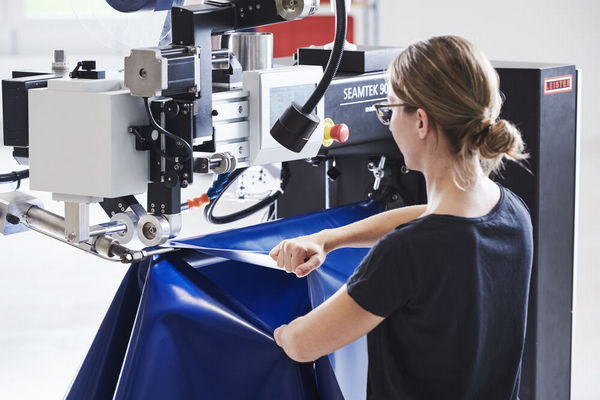
What is HF welding in textiles?
HF welding, also known as radio-frequency (RF) or dielectric welding, is a process used to join compatible thermoplastic materials.
In textile applications, the material may be a plastic film or a fabric with a suitable thermoplastic coating. Two layers are positioned between specialist electrodes, and a high-frequency electromagnetic field is applied.
The energy generates heat within the compatible material at the intended weld area. Pressure is then applied while the material cools, creating a permanent seam. Unlike conventional sewing, this process does not require thread or a needle to create the joint.
What textiles can be HF welded?
HF welding is not suitable for every type of textile. The material needs to contain a compatible thermoplastic component that can respond effectively to the high-frequency energy. Suitable materials can include certain:
- PVC films
- PVC-coated fabrics
- Polyurethane films
- PU-coated textiles
- TPU-based materials
- Other compatible thermoplastic-coated textiles
PVC-coated polyester is one example where HF welding can be particularly useful.
The exact material formulation is important, however. Two fabrics may look similar but behave differently during welding depending on their coating, thickness and construction.
You should therefore establish that the specific textile is suitable for HF welding before choosing the machinery and tooling.
How is HF welding machinery used in textile manufacturing?
HF welding machinery can be used to join sections of compatible textile materials and create the seams required for the finished product.
The basic process involves positioning the material between the welding electrodes. The machine then applies high-frequency energy to the required area while pressure is applied through the tooling.
Once the material has heated sufficiently, the HF energy is stopped and the joint is allowed to cool under pressure. This creates a sealed seam without requiring conventional stitching.
The process can be repeated across multiple products, allowing manufacturers to produce consistent welds once the appropriate settings and tooling have been established.
What textile products can be made using HF welding?
HF welding can be used across a range of textile and flexible-material applications. Depending on the material and product design, this can include:
- Waterproof garments
- Rainwear
- Protective clothing
- PVC and PU-coated products
- Bags and pouches
- Inflatable products
- Tarpaulins
- Covers
- Flexible containers
- Technical textiles
- Medical and healthcare products
HF welding can be particularly valuable when the finished product needs to prevent air or water passing through the seams.
Why is HF welding useful for waterproof textiles?
One of the main advantages of HF welding in textile applications is the ability to create sealed seams.
With conventional stitching, a needle creates small holes through the fabric and thread passes through the material. This can be perfectly suitable for many garments, but it may not provide the level of sealing required for waterproof or airtight products.
HF welding works differently. Where the textile has a suitable thermoplastic coating, the coating itself can be fused to create a continuous seam. This can make HF welding useful for products where water resistance or airtightness is an important part of the finished design.
How can HF welding improve textile production efficiency?
Efficiency is an important consideration for textile manufacturers, particularly where large quantities of products need to be produced to consistent standards.
HF welding can help improve efficiency because the welding process can be controlled and repeated using predetermined settings. Once the correct combination of power, pressure and welding time has been established, the same process can be used across multiple products. This can reduce variation between individual seams and make production more predictable.
HF welding can also provide rapid welding cycles, which can be beneficial when large numbers of similar components need to be manufactured.
Can HF welding create complex textile seams?
Yes. HF welding machinery can be used with tooling designed to create different seam shapes. This means you are not necessarily restricted to simple straight seams. Depending on the machine and tooling, you can create:
- Curved seams
- Angled seams
- Continuous seams
- Sealed edges
- Shaped welds
- Attachment points
Specialist tooling can be manufactured around the design of the product, allowing the welding process to follow particular shapes. This can be useful when manufacturing technical textiles or products with more complicated constructions.
Why is tooling important in textile HF welding?
Tooling is one of the most important parts of an HF welding system.
The tooling determines the area where the electromagnetic energy and pressure are applied. It therefore has a direct influence on the shape and consistency of the finished weld.
For a simple product, the tooling may only need to create a straightforward seam. For more complex textile products, the tooling may need to follow curves, corners or specific geometric patterns. The ability to develop tooling around the product can make HF welding a flexible option for textile manufacturers producing specialist components.
Can HF welding be automated?
Yes. HF welding can be incorporated into automated or semi-automated production systems. The level of automation required will depend on the product and production volume.
For smaller production runs, an operator may position the textile manually before starting each welding cycle. For higher-volume production, machinery can be configured to reduce manual intervention and improve consistency between cycles.
Automation can be particularly useful where the same product needs to be manufactured repeatedly, as the welding parameters and tooling can remain consistent.
How does HF welding improve consistency?
Consistency is particularly important in textile manufacturing because variations between products can affect both appearance and performance.
With HF welding machinery, parameters such as welding time, power and pressure can be controlled. Once the correct settings have been established for a particular material and product, they can be repeated across the production run. This can help create consistent seam widths and weld strength while reducing variation caused by manual joining techniques.
For manufacturers producing large quantities of the same product, this repeatability can be a significant advantage.
Is HF welding suitable for every textile manufacturer?
No. HF welding is most useful where the textile contains a compatible thermoplastic material.
If you are manufacturing conventional cotton, wool or other non-thermoplastic fabrics, sewing is likely to remain the more appropriate joining method.
HF welding becomes particularly interesting when you are working with coated or laminated textiles where the thermoplastic layer can be fused.
Before investing in machinery, you should consider the material, product design, expected production volume and the type of seams you need to produce.
What should you consider when choosing HF welding machinery?
If you are considering HF welding for textile production, the machinery should be matched to your specific requirements. You should consider:
- The type of textile being welded
- Material thickness
- Product size
- Weld dimensions
- Required production volume
- Manual or automated operation
- Tooling requirements
- Required seam strength
- Whether seams need to be airtight or watertight
- Scope for future production
The right machine can help you achieve consistent results while making the production process more efficient.
Choosing machinery that is too small, slow or inflexible for your requirements may create unnecessary bottlenecks.
So, how is HF welding machinery used in textiles?
HF welding machinery can be used to join suitable thermoplastic films and coated textiles by using high-frequency electromagnetic energy to generate heat within the material. The process can be particularly useful for PVC and polyurethane-based textiles where you need strong, consistent and sealed seams.
For textile manufacturers, the main advantages can include repeatable welds, rapid production cycles, reduced reliance on thread and the ability to create airtight or watertight seams. Specialist tooling can also allow you to produce straight, curved, angled and complex weld patterns.
HF welding is not a replacement for sewing in every textile application. However, where you are working with suitable thermoplastic-coated materials, it can provide an efficient alternative to conventional stitching.

Mayedul Islam is a Founder and Editor of Garments Merchandising. He is an Expert in Garments Merchandising. Writing is his passion. He loves to write articles about Apparel, Textile and Garment Washing specially on Merchandising. Mail him at mayedul.islam66@gmail.com