
There is a version of this conversation happening in warehouses all over Australia right now. That includes many garment, fabric and home textile distribution centres. Loads keep arriving at the customer with the film torn, cartons shifted, the top layer leaning. Someone suggests the obvious fix. Put more film on it.
So the operator adds another two revolutions, film usage climbs, and the loads keep failing anyway.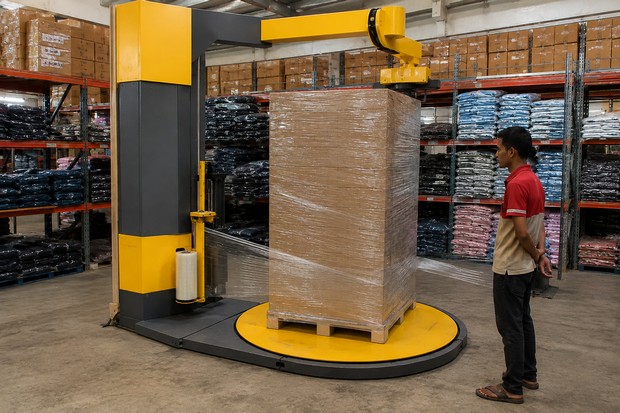
The reason is that wrap count is not what holds a pallet together. Containment force is. And once you understand the difference, most of the decisions around pallet wrapping get a lot easier, including whether it is worth automating in the first place.
Containment force, not wrap count
Containment force is the pressure the film applies inward to the load. It is a product of how many layers you apply, how much tension is in each layer, and how well the layers grip each other.
Hand wrapping is poor at all three. An operator walking backwards around a pallet applies whatever tension their arms happen to produce, which varies by person, by pallet and by how far into the shift they are. The film goes on loose, the load gets film on it without actually being held, and everyone concludes the pallet needed more wraps.
A machine applies consistent tension on every layer. That alone often fixes load failures without using any additional film. In many cases it uses considerably less. For textile and apparel distributors, that can mean fewer damaged cartons and less rework at dispatch.
Pre-stretch is where the money is
This is the specification that separates a cheap wrapper from one that pays for itself, and it is the one most buyers skip past.
Stretch film is designed to be elongated before it touches the load. On a machine with a powered pre-stretch carriage, two rollers stretch the film between them at a set ratio. A 240 per cent setting takes one metre of film off the roll and applies roughly three and a half metres to the pallet. Mechanical pre-stretch carriages sit lower, commonly in the range of 30 to 90 per cent. A basic brake carriage does not pre-stretch at all, it just resists the roll turning.
The practical effect is that a powered pre-stretch machine covers the same pallet using a fraction of the film weight, and the stretched film actually has more holding power because it is already under tension when it is applied.
The SIAT Onewrap range that Packserv distributes in Australia illustrates the ladder well. The LP model runs powered pre-stretch at 240, 200 or 150 per cent. The SM model uses a mechanical carriage at 90, 60 or 30 per cent. The FM, M and EM models use electromagnetic or mechanical brake carriages without pre-stretch, which keeps the purchase price down for lower volume operations.
If you wrap a decent number of pallets a week, the film saving on a powered pre-stretch machine is usually the single largest line in the payback calculation. If you wrap a handful, a brake carriage machine is the sensible buy and you should not let anyone talk you into more.
Work out your real film consumption first
Before you get quotes, do this. Weigh a full roll of film. Wrap a pallet the way your team normally wraps it. If you are shipping apparel cartons, fabric rolls or home textile packs, use the load your team actually handles day to day. Weigh the roll again.
That gives you grams of film per pallet, which is the number every supplier should be working from. Multiply it out across your weekly pallet count, apply what you actually pay per kilogram, and you have your current annual film spend.
Then add the labour. If a hand-wrapped pallet takes four minutes and you send out sixty a day, that is four hours of someone’s shift spent walking in circles. Machine cycle times are typically well under two minutes on a semi-automatic turntable, and the operator is only involved at the start and end.
Those two figures, film weight per pallet and minutes per pallet, will tell you more about whether to automate than any brochure.
Check the specs that will actually constrain you
Most disappointment with pallet wrappers comes from a mismatch between the machine and the site, not from the machine itself. Four things to verify before you commit:
Turntable diameter against your pallet footprint. A 1,500 mm turntable is the standard size and handles a typical 800 x 1,200 mm Australian pallet comfortably. Larger platforms up to 2,200 mm exist for oversized or overhanging loads. Measure your widest actual load, including any overhang, rather than the pallet dimension on paper.
Maximum load height, including the film overlap above the top edge. Standard configurations commonly reach around 2,100 mm, with taller options available. If your loads run high, this is a hard limit and not something you can work around later.
Maximum working load. Flat turntables handle substantially more weight than open or low profile turntable designs, so if you wrap heavy product this determines which platform type you need.
Power supply and site conditions. Check whether the machine is configured for single phase 220 to 240 volt or three phase 400 volt, and confirm what you have available at the wrapping station. Also check the operating temperature range. Machines rated for 5 to 40 degrees are common, which matters if you were planning to put the wrapper inside a chiller or cold store.
Do not forget the film you already buy
Every wrapper has limits on the roll it will accept. Film width, roll diameter, core size and film thickness all need to match. Cores are typically 76 mm and many machines cap out around 35 micron film thickness.
If your current film does not fit the machine, that is not a disaster, but it does mean a change of supply and possibly a different price per kilogram. Worth knowing before you sign rather than after the machine lands.
Lock the settings once you have them right
A detail that gets overlooked. Once a technician has dialled in your wrapping programmes, film tension, wrap counts at the top and bottom of the load, and edge overlap, those settings are the whole point of buying the machine.
If the control panel is open to everyone, someone will eventually decide a load looks a bit loose and wind the wrap count up, and your film saving quietly disappears over the following months. Machines with multiple stored programmes and a lockable control panel let you set a programme per product type and leave it alone.
Rent before you buy if you are unsure
Pallet wrapping is seasonal for a lot of Australian businesses. If your volumes spike before Christmas or through a harvest window and sit flat the rest of the year, rental and rent-to-buy arrangements are standard in this market and worth asking about.
It is also a reasonable way to test whether a powered pre-stretch machine actually delivers the film saving on your specific product before you commit capital to it.
The short version
Loads fail because the film is applied without consistent tension, not because there is not enough of it. That is just as true for garment and textile shipments as it is for any other warehouse load. Fix the tension and you usually fix the failures while spending less on film.
Weigh your film per pallet. Time your current process. Measure your tallest and widest load. Then have a conversation with a supplier about pre-stretch, because that is the specification that decides what the machine costs you over the next decade.
Packserv has manufactured and supplied packaging machinery in Australia since 2007, with technical support across Sydney, Melbourne, Brisbane, Adelaide and Perth, including sites handling apparel, fabric and home textile goods. As the Australian distributor for Italian manufacturer SIAT, their range spans semi-automatic turntable models through to automatic in-line systems, and a pallet wrapping machine can be bought, rented or acquired on rent-to-buy terms.

Mayedul Islam is a Founder and Editor of Garments Merchandising. He is an Expert in Garments Merchandising. Writing is his passion. He loves to write articles about Apparel, Textile and Garment Washing specially on Merchandising. Mail him at mayedul.islam66@gmail.com