
A 100% cotton label does not automatically make a garment print-ready.
Two T-shirts may have the same fibre composition, a similar GSM and the same colour, and both may satisfy conventional garment-quality requirements. Yet one may consistently produce sharp, repeatable DTG output while the other exhibits fibre interference, uneven colour density, softer edge definition or noticeable variation across a production run.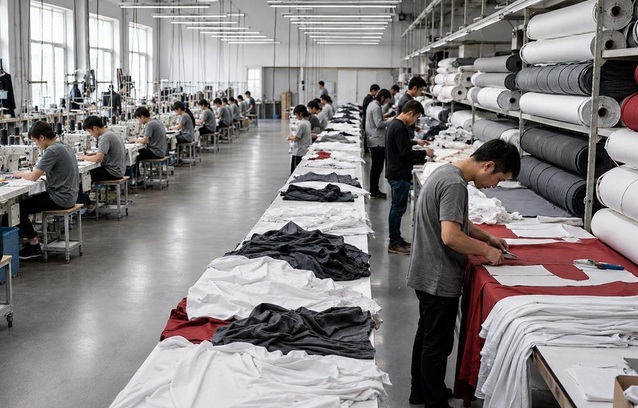
If the labels appear similar, where does that difference come from?
A printer does not receive a neutral piece of cotton. It receives a surface created through fibre selection, yarn production, knitting, dyeing, finishing and garment assembly. By the time pretreatment, ink, heat and pressure enter the process, many of the variables influencing print behaviour have already been established.
The print surface is therefore a production component: the outcome of decisions made throughout textile and garment manufacturing, not simply a neutral background for decoration. Understanding those upstream variables helps explain why apparently similar garments can behave very differently during digital garment production.
A Fibre Label Does Not Describe the Print Surface
Fibre composition remains one of the first specifications to consider when evaluating a garment for digital decoration, and for good reason. It provides useful information about the substrate and helps establish whether a particular print process is likely to be appropriate.
It is not, however, a complete description of the surface that will receive the print.
A composition label reveals what fibres are present. It does not describe how those fibres have been spun, how the fabric has been knitted, how compact or porous the surface has become, what finishing treatments have been applied or how dimensionally stable the finished garment will remain. Two garments carrying the same “100% cotton” label can therefore present markedly different printable faces.
That distinction matters in DTG production because pretreatment and ink interact directly with the garment surface. Small differences that may appear insignificant during conventional garment inspection can become much more visible once pretreatment, ink, heat and pressure are introduced.
Cotton illustrates the point well. Its fibres generally provide a receptive and absorbent substrate for water-based digital garment inks, which is one reason cotton remains widely used within DTG production. Absorbency alone, however, should not be mistaken for print readiness. A highly absorbent or open surface may allow ink to penetrate more deeply than intended, weakening colour strength, opacity, edge definition or image clarity.
Pretreatment helps regulate that interaction, but it does not make every cotton garment respond in the same way. The chemistry used during printing must still work on a surface already shaped by spinning, knitting, dyeing and finishing.
The same principle applies to polyester and blended fabrics. Neither should be treated as inherently suitable or unsuitable for digital garment decoration. Different fibre combinations may require different controls around pretreatment, curing, dye migration, colour contamination and production testing. Compatibility depends on the interaction between the garment and the specific print system, not simply the fibre name on the label.
Fibre composition indicates what a garment is made of. It does not fully explain how the surface will behave.
Yarn and Knit Construction Create the Printable Face
If fibre composition establishes the raw material, yarn formation and knit construction determine how that material is presented to the printer.
Knitting creates the basic printable face, although later dyeing and finishing continue to modify it. Yarn selection, yarn quality and loop formation influence the smoothness, regularity and stability of the surface that will later receive pretreatment and ink. Those characteristics rarely appear on a standard composition label.
Surface hairiness provides a useful example. As fibres project beyond the primary yarn structure, they introduce small variations across the fabric face. Once pretreatment and ink are applied, those exposed fibres may contribute to softer image edges, local variation in colour density, inconsistent white underbase coverage or a rougher visual finish. A smoother yarn cannot guarantee a perfect print, but it generally gives the printer greater control than an irregular or highly hairy surface.
Knit construction extends that principle from the yarn to the fabric itself. In weft-knitted single jersey, loop formation, stitch density, machine gauge and overall compactness influence whether the surface remains relatively smooth and uniform or becomes more open and irregular. Those characteristics affect pretreatment distribution, ink penetration and repeatability across garments.
The relationship should not be reduced to one ideal knit specification. No single stitch density, gauge or loop length guarantees superior print performance. Those variables interact with yarn characteristics, finishing treatments, pretreatment chemistry and the decoration process itself. Their value lies in how predictably they contribute to the surface’s overall behaviour, rather than in any fixed numerical target.
The same caution applies to GSM. GSM measures fabric mass per square metre. It does not measure print readiness. A heavier garment may still present a textured face, significant yarn hairiness, an open structure or poor dimensional stability. A lighter fabric may sometimes offer a smoother and more controlled printable surface.
Dimensional stability also matters. A print may appear acceptable immediately after curing but may perform differently if the garment later shrinks, twists, spirals or changes dimensions during laundering. Decoration cannot prevent movement introduced by the underlying fabric structure.
Yarn and knit construction, therefore, establish the conditions within which every subsequent production stage must operate. The printable face is the visible outcome of decisions made at yarn and loop level.
Dyeing and Finishing Change How the Surface Behaves
The printable surface continues to evolve after knitting.
Dyeing changes more than the garment’s colour. The base shade becomes part of the finished printed result, particularly where white ink, opacity and curing interact with the substrate. Shade depth, dye fixation, residual unfixed colour and variation between dye lots can all influence appearance and consistency once the garment enters production.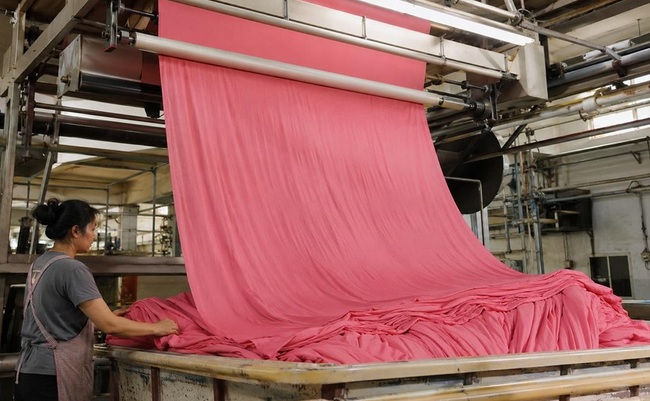
Finishing modifies the surface again. Treatments intended to improve softness, appearance or handle may also alter wettability, absorbency, smoothness, pretreatment uptake, ink penetration, rub fastness and wash performance. Those changes are not automatically beneficial or detrimental to DTG production, but they create a different substrate that must be tested rather than assumed to behave like an untreated equivalent.
Pretreatment illustrates the interaction clearly. It belongs to the decoration process, but its effectiveness depends in part on the surface already created through spinning, knitting, dyeing and finishing. Uneven uptake, variable spreading or inconsistent white-ink holdout may therefore arise from the interaction between the garment and the print process rather than from a single stage in isolation.
Immediate colour strength is only one measure of success. Edge definition, hand feel, wash durability, rub fastness, dimensional stability and repeatability across multiple garments also matter. A garment that initially produces vibrant colour but behaves inconsistently after curing or laundering may still pose a production risk.
Repeat orders often reveal that risk. The same artwork, machine settings and workflow may produce a visibly different result if a replacement garment batch changes in shade, surface texture, finishing response or dimensional behaviour. The print process may remain constant even as the substrate changes.
The printer therefore receives not only a fibre and a knit structure, but the accumulated effects of every chemical and mechanical process applied afterwards.
Garment Construction Defines the Usable Print Surface
A printable fabric does not automatically become a print-compatible garment.
Once fabric is cut and assembled, garment construction begins defining the practical surface available for decoration. Seams, pockets, plackets, zips, panels, bindings, reinforcement and changes in fabric thickness all influence how easily artwork can be positioned and reproduced during production.
That distinction is particularly relevant for DTG because the process depends on presenting a stable, relatively flat surface to the print system. Raised construction features can affect garment positioning, reduce the usable print area, alter printhead clearance and introduce additional variation between otherwise identical garments. Whether those features become problematic depends on the garment, artwork and production method rather than any single design element in isolation.
The objective is therefore not to eliminate construction features but to consider decoration requirements during product development.
A pocket placed within the intended artwork area, a decorative seam crossing a large graphic or a panel line interrupting the design may all increase production complexity long before the garment reaches the printer. Considering decoration requirements during garment development allows those decisions to be evaluated while they remain relatively inexpensive to change.
Construction also influences how garments behave after printing. Heat curing, repeated wear and laundering place stress on the assembled garment rather than the fabric alone. Movement introduced through seams, panels or dimensional change can therefore affect how consistently a printed image performs throughout the life of the garment.
The printable surface is shaped not only by the fabric itself but also by how the fabric is assembled into a finished product.
Print Performance Depends on Both the Garment and the Process
Direct-to-garment decoration makes the underlying surface visible.
Unlike decoration methods that introduce an intermediate transfer layer, DTG printing applies ink directly to the garment face. Variations in smoothness, porosity, fibre exposure, pretreatment response and dimensional stability therefore become part of the finished image rather than remaining hidden beneath another material.
Drawing on its experience producing digitally printed garments across a wide range of blanks, the team at The T-Shirt Bakery, a UK DTG printing company, has found that visually similar garments can behave very differently once pretreatment, ink, heat and pressure are introduced.
That difference does not necessarily indicate a manufacturing fault. Fibre selection, yarn formation, knit construction, dyeing, finishing and garment assembly each contribute to the printable surface before decoration begins. Small differences across those stages can produce noticeably different printing behaviour even when two garments appear almost identical during visual inspection.
At the same time, garment selection is only part of the equation.
A well-engineered garment cannot compensate for poor production practice. Uneven pretreatment, incorrect platen loading, unsuitable curing conditions, inadequate machine maintenance and operator error can all reduce print quality on an otherwise compatible substrate. Reliable production depends on controlling both the garment and decoration processes rather than assuming that either can compensate for shortcomings in the other.
Manufacturers and printers achieve the most consistent results when they treat garment development and decoration as connected production stages rather than separate disciplines. Evaluating garments under realistic production conditions allows teams to assess compatibility before full production, reducing variation across repeat orders and improving predictability.
The Surface Arrives Before the Printer
A fibre label indicates what a garment is made of, but it cannot fully explain how the garment will behave during decoration.
The printable surface has already been shaped through fibre selection, yarn production, knitting, dyeing, finishing and garment assembly before pretreatment or ink ever enters the process. By the time a garment reaches the print room, many of the variables influencing print quality, repeatability and long-term performance have already been established.
Recognizing the print surface as a production component encourages garment manufacturers, merchandisers and printers to evaluate decoration compatibility alongside more familiar measures of garment performance. Instead of treating printability as a final-stage consideration, teams can account for it throughout the manufacturing process.
Dependable DTG production ultimately relies on both sides of the equation. A well-controlled print process cannot make every garment behave identically, just as a carefully engineered garment cannot compensate for poor production control.
The print surface is not created in the print room. It arrives there.

Mayedul Islam is a Founder and Editor of Garments Merchandising. He is an Expert in Garments Merchandising. Writing is his passion. He loves to write articles about Apparel, Textile and Garment Washing specially on Merchandising. Mail him at mayedul.islam66@gmail.com